climate infrastructure
Own What You Host
2026-09-22 · 6 min read
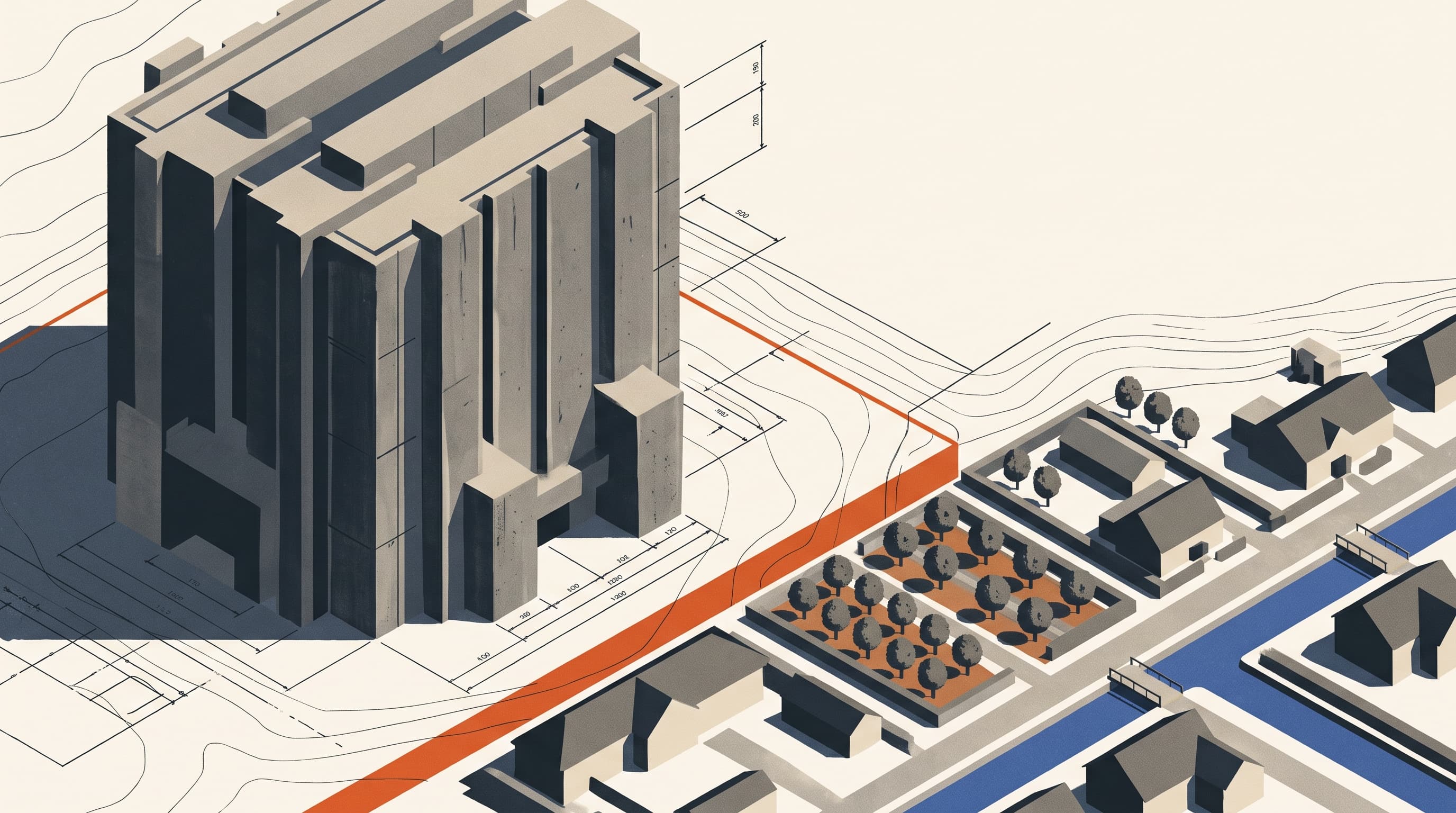
Every fight over a data center plays out like a bad community theater production where everyone already knows how the script ends.
- Act one: an infrastructure developer arrives in town with clean architectural renderings, an out-of-state capital partner, and promises of high-tech tax revenue.
- Act two: the local council holds a three-minute public comment session where neighbors bring up water tables, humming diesel generators, and soaring electric bills.
- Act three: the community discovers the deal offers only two buttons on the dashboard, surrender or sue.
In Prince George's County, Maryland, the community picked the second button. Faced with a massive hyperscale facility proposed for the old Landover Mall site, more than twenty thousand residents signed a petition, organized across kitchen tables, and pushed their county council into passing a two-year moratorium on hyperscale data centers.
The tech sector often writes this off as reflex NIMBYism or economic self-sabotage. That's lazy thinking. When a development model hands a town all the ecological and electrical collateral damage while funneling every dollar of equity to an investment fund thousands of miles away, blocking the project is the only rational move left on the board.
A moratorium is not an anti-technology tantrum. It's a desperate bid for leverage.
The trouble is that a moratorium builds nothing. It's a pause button on a ticking timer. When the two years run out, the economic pressure to build will remain, the compute shortfall will be worse, and the developer will be back with better lawyers.
To break the stalemate, we have to look past the zoning board and look at the financial plumbing.
The lie of the all-or-nothing bundle
Every standard data center deal rests on an unexamined assumption: whoever writes the equity check must own the operational steering wheel.
If an infrastructure fund brings eight hundred million dollars to the table, the fund gets the cash flows, the depreciation tax write-offs, the real estate title, and the sole right to decide how hard the facility strains the local grid. The host community gets whatever scraps fall out of a Community Benefits Agreement, maybe a refurbished baseball diamond, a donation to the local high school robotics lab, and a round of ribbon-cutting photos.
We treat this bundling of money and power like a physical law, as if you can't pour concrete without surrendering self-governance.
Yet outside the data center echo chamber, capital markets decouple money from control all the time. Dual-class stock structures let founders run tech giants with minority economic stakes. Real estate investment trusts hand dividend yields to passive public investors while keeping management locked inside an operating partner. Infrastructure bondholders fund toll roads and municipal water plants across the world without demanding the right to reset speed limits or rezone the highway shoulders.
Separating economics from governance is an everyday tool when it protects institutional capital. It's treated as exotic only when someone suggests using it to protect the neighborhood next door.
The power-and-concrete e-corporation
Years ago, a group of Stanford economists designed a structure called an e-corporation, originally aimed at gig-economy platforms like ride-sharing and food delivery. The pitch was straightforward: let institutional investors collect a competitive, reliable financial return, while handing the platform's governance, algorithmic rules, and workplace protections to a cooperative of workers and users.
The idea stalled, and the reason it stalled is instructive. Venture capitalists were being asked to underwrite two massive unknowns simultaneously: an unproven, volatile business model and a novel community governance system. In finance, compounding novelties kills deals.
Data centers dissolve that friction entirely. A hyperscale data center is not a messy consumer app burning cash to acquire users. It's heavy infrastructure: concrete slabs, high-voltage transformers, and fifteen- to twenty-year master contracts with investment-grade tenants like Microsoft, Amazon, or Google. Its cash flow behaves less like a startup and more like a municipal water utility.
Because the financial return of a data center is predictable and secure, the governance side can finally stand on its own feet.
Under the Own What You Host model, the project company splits into two pieces:
- Class A shares (the capital): outside institutional investors bring the debt and equity, retain all depreciation tax advantages, and collect 100% of the contracted commercial profits.
- Class B shares (the host): the community, represented by a permanent, non-profit member-governed entity, holds permanent voting authority over the boundary conditions where the facility touches the living world.
Drawing the line at the fence
The immediate objection from any data center operator hearing this proposal is predictable: you can't let a town council vote on server rack configurations or dispatch algorithms, not with a 99.999% uptime guarantee on the line.
They're right. You cannot run a mission-critical facility by town hall referendum. The answer is a hard legal line between internal technical operations and external boundary envelopes.
What the operator controls
Inside the walls
- Chip architecture & rack layout
- Server workload management
- Chiller plant dispatch
- Generator maintenance timing
What the community controls
At the property line
- Substation peak-demand limits
- Potable water consumption caps
- Perimeter acoustic limits
- Phase II physical expansion veto
The community doesn't tell the engineers how to cool the servers. Instead, it holds an ironclad, contractually binding cap on how many gallons of potable drinking water the plant can pull from the aquifer each month. If the plant needs more cooling, the operator is free to innovate: closed-loop chillers, treated wastewater, dialed-back compute density.
The community doesn't dictate when the facility tests its backup diesel engines. Instead, continuous property-line decibel and particulate monitors feed raw data into an immutable, public dashboard. If emissions breach the agreed limits outside a declared grid emergency, pre-set financial damages flow automatically into a neighborhood fund, and future expansions are legally frozen until the systems are back in balance.
No subjective political votes. No midnight emergency shutoffs. Just clear, measurable environmental guardrails enforced through corporate equity rather than zoning petitions.
The third position
For developers and lenders, this sounds like a concession. Look at the balance sheet, and it looks like an unlock.
Right now, the average hyperscale data center spends two to four years trapped in entitlement purgatory: lawsuits, rewritten zoning applications, interest on idle land, the risk of an outright legislative ban. In infrastructure finance, two years of delay destroys far more internal rate of return than closed-loop chillers or a community mitigation escrow ever would.
By giving the community structural governance, the project trades indefinite legal hostility for entitlement velocity. When neighbors become constitutional stewards of the site rather than collateral damage, projects move from permit to ribbon-cutting in months instead of years.
Prince George's County has the runway, an energized populace, and an active moratorium that proves the old model is broken.
The moratorium was the sound of a community slamming the door on an extractive deal. The e-corporation is the blueprint for opening that door on terms both sides can live with. The question isn't whether we build the digital future. It's who gets a seat at the table when we do.
Enjoyed this?
New essays land in your inbox as they're published. No spam, no growth-hacking, unsubscribe whenever.