climate infrastructure
Truth Is Infrastructure
2026-09-22 · 4 min read
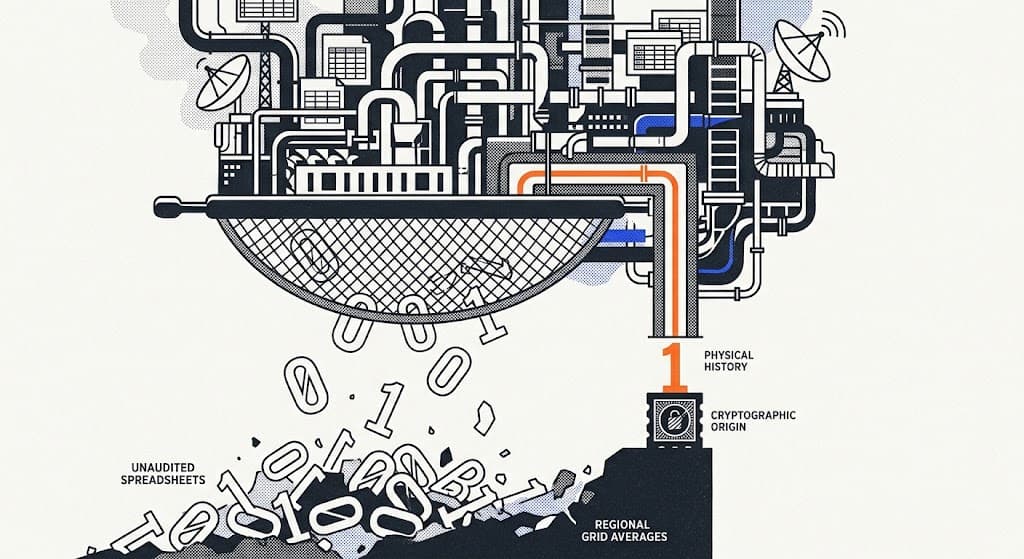
Most verification systems run on estimates. Voluntary carbon markets price credits off modeled counterfactuals. Corporate ESG accounting aggregates unaudited spreadsheets. AI compute emissions get derived from regional grid averages multiplied by nominal server draw.
The problem isn't data volume. Registries, satellite feeds, and compliance disclosures produce petabytes of numbers every year. The problem is that almost none of that data carries the physical history of how it was produced.
When a number can be modeled, interpolated, or inferred without carrying the mechanical or cryptographic trail of its own origin, the market built on top of it has no floor.
The value isn't the axis. The method is.
Ask two different questions about the same number: what is it, and how was it produced.
In most climate registries and corporate disclosures, an entry like 1,420 tCO2e removed renders identically whether it came from:
- A hardware-signed gas analyzer on-site, streaming continuous telemetry.
- A quarterly manual meter reading, written down on a clipboard.
- A regional proxy model running inside a vendor's black box.
Provenance, the live interactive demo, changes the axis. Instead of coloring data by the value (green for low emissions, red for high), it colors data by where the number came from:
| Source | Ingestion pattern | Trust tier | Integrity signal |
|---|---|---|---|
| Hardware-signed telemetry | Cryptographically bound | High-assurance | Tamper-evident proof generated at the sensor edge |
| Batch sensor sync | Periodic ingestion | Attested | Automated device telemetry, delayed or batched |
| Modeled or static proxy | Derived extrapolation | Unanchored | Top-down mathematical inference without device roots |
The realization is immediate once you see it this way: provenance carries more economic weight than the value itself.
A measurement of 500 kg CO2, hardware-attested and timestamped to a specific grid node, is verifiable collateral. A measurement of 450 kg CO2, averaged quarterly across three countries, is an unhedged liability wearing a lower number. In a compliance market, the first is an asset. The second is a lawsuit waiting on discovery.
Continuous verification, not episodic audits
This is the operating thesis behind digital MRV (dMRV): replace periodic manual audits with continuous, sensor-driven verification. It's the same thesis Mālama Labs is building at company scale, stated here at the protocol level instead.
Traditional MRV sends a consultant team to a facility once every 12 to 24 months, runs spot checks, and produces a retroactive PDF. That model breaks at institutional scale for three structural reasons:
- High latency. Time to issuance runs months to years, tying up project financing and compounding counterparty risk the entire way through.
- Fragile trust anchors. Verifiers audit the paperwork about the measurement, not the measurement itself.
- Episodic blindness. Leaks, shutdowns, and reversal events between audit cycles get smoothed out of the annual number entirely.
dMRV moves verification from a retroactive opinion to an active protocol layer. Physical sensors, open ingestion pipelines, and cryptographic hardware signatures combine to produce continuous proof of state, asserted directly at the edge and pushed to a ledger no one can quietly edit.
The missing substrate
| Feature | Legacy carbon & ESG | Hardware-anchored dMRV |
|---|---|---|
| Data ingestion | Annualized manual reports and proxies | Continuous telemetry from edge hardware |
| Audit cadence | Episodic, every 12 to 24 months | Real-time state updates |
| Trust model | Trust in third-party paper attestations | Cryptographic hardware attestation |
| Traceability | Static PDF certifications | Queryable pipeline, sensor to ledger |
Without this substrate, carbon credits, Renewable Energy Certificates (RECs), and compute-energy disclosures are unsecured credit lines issued against goodwill. If a buyer can't trace the chain of custody from the physical sensor to the registry balance, the asset has no floor under it.
Markets can't price what they can't trust, and they can't trust a number whose production history is invisible. Building the provenance layer isn't a sustainability nice-to-have. It's the prerequisite for treating climate metrics as real financial primitives.
Explore the live Provenance demo to compare sensor-attested numbers against proxy models in real time.
Enjoyed this?
New essays land in your inbox as they're published. No spam, no growth-hacking, unsubscribe whenever.